
What is a fisheye lens, and how does it work?
Fisheye lenses are surreal. Learn what they are and how to use them.


We’ll cover:
- What is a fisheye lens?
- Who invented the fisheye lens?
- Why would you use a fisheye lens?
- How does a fisheye lens work?
- Fisheye vs. wide-angle lens: What’s the difference?
- What’s the best fisheye lens to buy?
- Does the iPhone have a fisheye lens?
- What are the disadvantages of a fisheye lens?
- How do you remove fisheye distortion?
- How to shoot with a fisheye lens
- What are the best fisheye shots?
What is a fisheye lens?
A fisheye lens is a camera lens used to capture extremely wide angles, usually at 180 degrees. For this reason, they’re often called super-wide, ultra-wide, or curvilinear lenses.
These spherical, unnatural angles lead to distorted and bent imagery, which filmmakers use to hammer home a specific vibe: ridiculous, bizarre, uncanny. If used to highlight landscape, a fisheye lens offers a panoramic, if not entirely realistic, view.
Who invented the fisheye lens?
In 1906, physicist Robert W. Wood was experimenting with a pinhole camera, a bucket of water, some mirrored glass, and light. He wanted to see what life looked like through the eyes of a fish.
Fish see things from a much wider angle than us, taking in the world at nearly 180 degrees from both sides. That’s why Wood called his contraption a fisheye lens.
Following the lens’ birth, Wood patented a host of inventions, from circus-style gimmicks to a disk that calculates the age of stars. Other scientists and inventors ran with this idea from the 1910s onward, developing the fields of meteorology and astronomy. Eventually, the ultra-wide fisheye lens made its way into consumers’ hands, most notably via Nikon in the 1960s and ‘70s.
Why would you use a fisheye lens?
Fisheye lens photography looks unique. It’s highly stylized and doesn’t work in every situation, but when it hits, it’s magic. That’s why so many music videos and skate compilations used fisheye lenses in the 1990s. They presented the content in a novel way, making potentially generic shots feel dynamic and bringing viewers closer to the action.
Not every shot will work through a fisheye lens, though. It would probably ruin your favorite episodes of Friends.
How does a fisheye lens work?
A fisheye lens uses special mapping to bend a 3D image into a 2D version. There are two main kinds of fisheye lens: full-frame and circular.
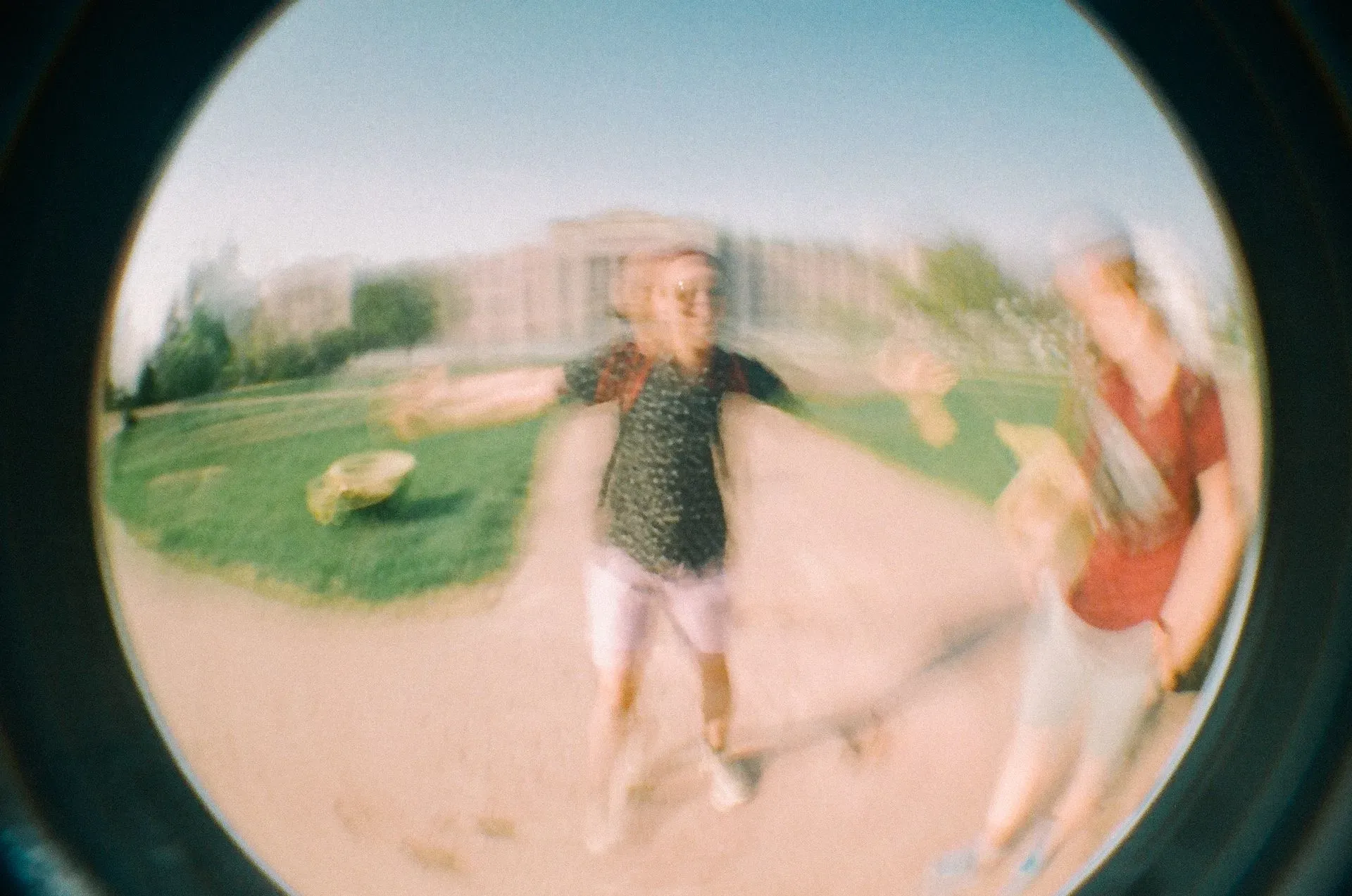
Full-frame fisheye lenses — also called diagonal fisheye lenses — fill the entire frame. Circular fisheye lenses project the image as a circle in the center of the frame. Circular fisheye shots were popularized in the 1990s, but as the album cover below suggests, they haven’t gone away.
Fisheye vs. wide-angle lens: What’s the difference?
A wide-angle lens uses rectilinear projection, meaning it keeps straight lines straight. A fisheye lens uses curvilinear projection, bending straight lines to accommodate a wider view.
While focal length isn’t strictly what makes a lens fisheye, it’s good to keep in mind. On a full-frame camera, 35mm or shorter is considered a wide-angle lens. Dipping below 24mm enters ultra-wide territory, while most fisheye lenses live between 8mm and 16mm.
| Wide-angle lens | Fisheye lens | |
|---|---|---|
| Projection | Rectilinear, meaning straight lines stay straight | Curvilinear, meaning straight lines bend |
| Field of view | Roughly 63 to 120 degrees | Usually 180 degrees |
| Focal length (full frame) | 35mm down to around 12mm | Between 8mm and 16mm |
| Distortion | Minimal, corrected in the glass | Deliberate and extreme |
| Best for | Landscapes, interiors, architecture, vlogging | Skate and BMX, music videos, action cams, VR, experimental film |
| Fixable in post? | Nothing much to fix | Yes, but you lose edge resolution |
Every fisheye is ultra-wide, but not every ultra-wide is a fisheye. The difference isn’t how much you fit in, but whether the straight lines remain intact.
What’s the best fisheye lens to buy?
You can get started with fisheye lenses for under $100, or spend thousands on expert equipment. Here are three popular options from BRIGHTIN STAR, Rokinon, and Canon.
BRIGHTIN STAR MF 10mm F5.6 II APS-C – $74.99
This 10mm BRIGHTIN STAR offers a 173-degree fisheye perspective, and is compatible with mounts including Sony E, Canon EOS-M, Nikon Z, Fuji X, and more. This is a manual-focus, budget-friendly option that’s great for trying out fisheye compositions.
Rokinon 8mm F3.5 Fisheye – $349
Rokinon’s fisheye lens offers minimal ghosting and flare, keeping your footage crisp. The lens focus is fully manual and the unit comes with a petal-style hood, giving it an old-school feel. It’s compatible with Canon EF, Sony E, and Nikon F cameras, covering anywhere between 167 and 180 degrees. Rokinon notes that the lens will produce a vignetted image on full-frame sensors.
Canon RF7-14mm F2.8-3.5 L Fisheye STM – $1,899
This ultra-wide option from Canon is the world’s first 190-degree fisheye zoom lens, achieving said circular coverage at 7mm, and a diagonal 180-degree view at 14mm. It’s packed with features, including drop-in rear filters, autofocus, a minimum focus distance of just 5.9 inches, and more.
Does the iPhone have a fisheye lens?
Not a true one. Even on the iPhone 17 Pro, the widest camera is a 13mm-equivalent ultra-wide with roughly a 120-degree field of view. That’s still pretty wide, but it’s rectilinear, and nowhere near the 180 degrees of a “real” fisheye lens.
To capture fisheye-style footage on an iPhone, you need a clip-on lens or an app. Here are a couple of options:
- Clip-on lenses: SANDMARC produces a 10mm fisheye lens for the iPhone 17 Pro, retailing for $139.99. Generic clip-ons are cheaper.
- FishEyeVideo Square: A free app featuring nine different fisheye effects. The full “lens” suite and unwatermarked exports are locked behind $0.99–$1.99 in-app purchases. FishEyeVideo Square is available on the App Store.
What are the disadvantages of a fisheye lens?
Fisheye lenses are popular for a reason: aesthetics. If those aesthetics aren’t right for your content, they’ll be noticeable. Here are some potential disadvantages:
- The distortion is built into the shot. You can straighten it in post-production, but may lose resolution around the edges.
- Edges stretch. Anything near the border of the frame — faces especially — gets pulled out of shape.
- Filters and hoods can be tricky. Most fisheyes have a bulbous front element, so standard screw-on filters and lens hoods won’t fit.
- You’re (probably) in the shot. At 180 degrees, it’s easy to catch your own feet, fingers, shadow, or tripod legs.
- It has one trick. The fisheye effect is unmatched when called for, but doesn’t make sense beyond that context.
If you’ve worked fisheye footage into your shot list and it suits your content’s aesthetic, you’ve got nothing to worry about. Embrace the weirdness.
How do you remove fisheye distortion?
You can quickly remove fisheye distortion with programs like Adobe Lightroom and Premiere Pro. This process is also known as defishing.
- Lightroom: Try manually lowering the “Distortion” slider housed in the “Lens Corrections” panel. This panel may also be called “Optics.”
- Premiere Pro: The “Lens Distortion” effect can help tone down overbearing fisheye.
Defishing stretches the corners of your footage; you’ll lose resolution at the edges and may need to crop the content. If you want to shoot with a fisheye lens and plan to straighten it in places, consider shooting wider than required.
How to shoot with a fisheye lens
Here are six tips to shoot footage with a fisheye lens:
- Get closer than feels “normal.” A fisheye lens flattens distance. The effect really shines when you stand closer to your subject.
- Keep an eye on the horizon. A horizon through the center of the frame stays straight. Move it up or down, and you’ll notice that it curves. Sometimes that’s the desired effect, but it often isn’t.
- Keep faces away from corners. “Edge stretch” is unforgiving on people. Center your subject, unless you intend to do strange things to their face.
- Check the frame for you. 180 degrees can catch feet, fingers, shadows, and filmmaking equipment. Do a sweep before you shoot any footage.
- Stop down for sharpness. Most fisheye lenses are noticeably softer at the corners wide open. Setting the f-stop to around f/5.6–f/8 will let more light into the lens and sharpen a close-quarters subject. Keep in mind that this will blur the background.
- Use your fisheye lens sparingly. One or two fisheye shots in a sequence hit hard. They’re weird. Unexpected. A whole video of them can be exhausting.
What are the best fisheye shots?
Now that we’ve covered what a fisheye lens is, where it comes from, and why it’s used, let’s wrap up with three best-in-class examples of fisheye lenses in action.
Francis Bourgeois
You might know Francis Bourgeois as “the train guy.” The British content creator shot to fame during the UK’s COVID lockdown, when he went trainspotting with a fisheye GoPro strapped to his head.
The result? Uncanny interactions between Bourgeois and rail staff, his excitement intensified by the extreme fisheye close-up. His TikTok account went viral, and he’s since enjoyed a modeling career, a book deal, and a hosting slot on Prime Video’s The Grand Tour.
@francis.bourgeois Quite unusual to bump into Percy Pig, a British icon. This year, we’re celebrating 30 years of Percy Pig and I want to make sure it’s a great day for him! (AD)
♬ original sound - Francis Bourgeois
Yorgos Lanthimos – Poor Things
Yorgos Lanthimos is the modern master of the fisheye lens. The Greek filmmaker’s Oscar-winning 2023 movie, Poor Things, uses fisheye shots to build a distorted, dreamlike quality...which really makes sense if you’ve watched the film.
What’s arguably as important is that Lanthimos knows when not to use the fisheye lens. His 2025 film, Bugonia, was notable for its light-touch use, which only made it more effective.
TLC – No Scrubs
Hype Williams’ music videos defined the look of the 1990s. No Scrubs. No notes.
Fisheye lenses make your content stand out. They give your shots that extra jolt of electricity, the push they might need to convey a particular point. To tell your story.
Tell your story, your way, with Epidemic Sound.
More than 55,000 tracks made by real artists. Smart tools to help you find, edit, and sync music in your video. Globally cleared licensing. No surprises.

Frequently asked questions about fisheye lenses
What is a fisheye lens used for?
Fisheye lenses are used for skate and BMX videos, music videos, action-camera footage, and 360-degree or VR capture. They work best when a shot needs to feel close and slightly unreal. On a more practical level, meteorology and astronomy professionals have used fisheye lenses for over a century.
Is a fisheye lens the same as a wide-angle lens?
No. Both capture a wide view, but a wide-angle lens is rectilinear, meaning straight lines stay straight. A fisheye lens is curvilinear, bending straight lines to squeeze in a wider field of view. Every fisheye is ultra-wide, but not every ultra-wide is a fisheye.
What focal length is a fisheye lens?
On a full-frame camera, fisheye lenses typically run from focal lengths of 8mm to 16mm. At around 8mm, you get a circular fisheye: a round image floating inside a black frame. At around 15mm to 16mm, you get a full-frame, or diagonal, fisheye that fills the frame corner to corner. Both capture 180 degrees; they just distribute it differently.
Why do skate videos use fisheye lenses?
Because the person filming has to be close to the subject. A fisheye lens lets you shoot from a few feet away and still fit the whole trick, the board, and the terrain into frame, while the distortion exaggerates speed and height. It became the visual language of 1990s skate videos and never really left.
Can you use a fisheye lens for portraits?
You can, but only if you want them to look stylistically distorted. Anything near the edge of the frame is stretched, so center your subject and get in close. Done deliberately, it’s a striking, absurd look.
Related posts: