
Behind the Sound: Eva Hummingbird
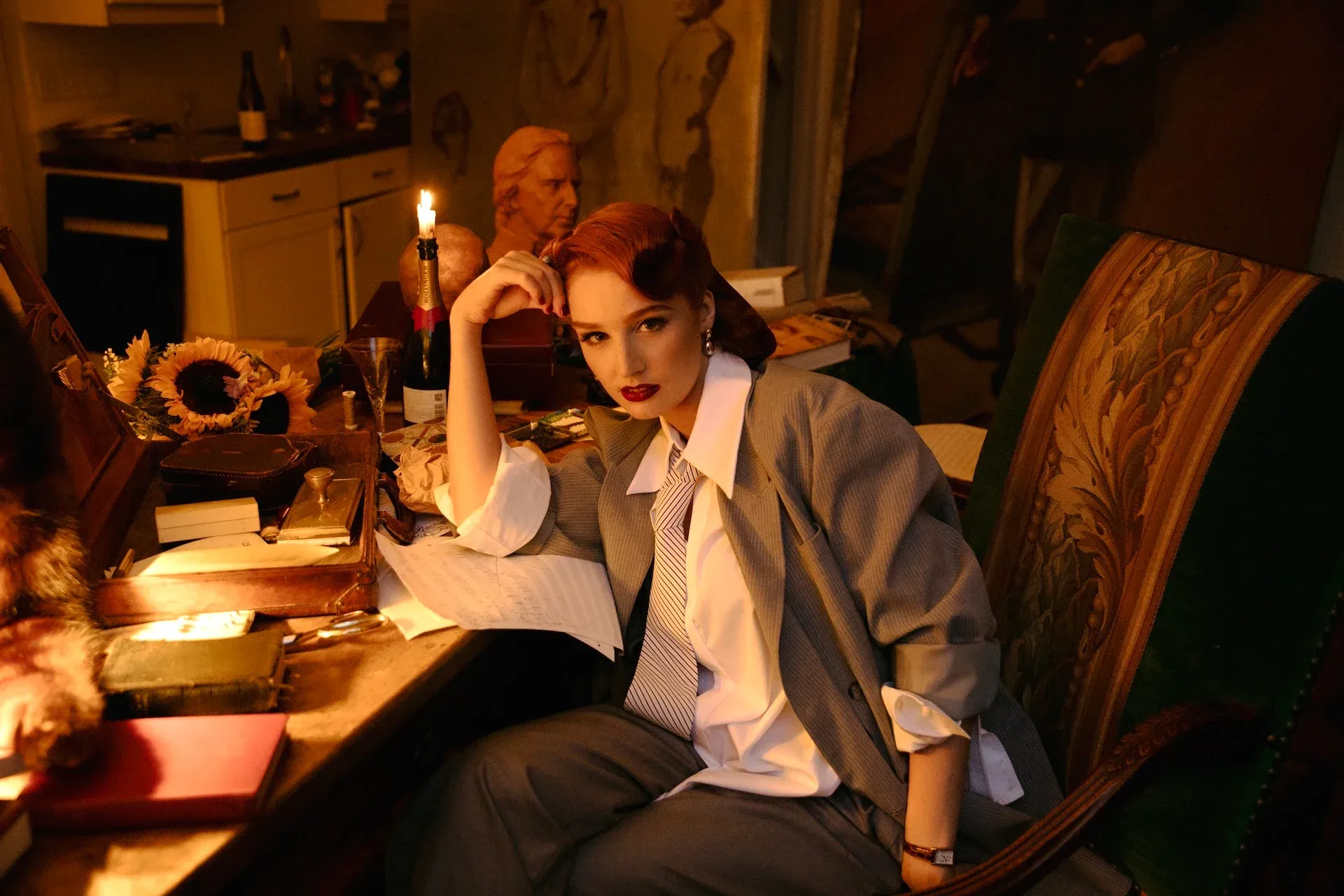
Discover Ceskie and her alter ego, Eva Hummingbird: a 1940s violinist, composer, and double agent.

Epidemic Sound is the world’s premier soundtracking platform because of our artists. Together, we help everyone from new creators to iconic brands find their voice.
In the latest edition of Behind the Sound, we introduce 1940s violinist, composer, and double agent, Eva Hummingbird.
1940s violinist. Double agent. That’s right. Kind of. Hummingbird is the alter ego of UK artist and producer Ceskie, born from the Covid-19 pandemic.
After escaping to London at the start of WWII, Hummingbird makes a name for herself, performing as Eva Hummingbird & the Maestros in underground jazz clubs. At the peak of her popularity, her Dutch refugee status is discovered, forcing her to become a British double agent.
Alone in Paris with no safe way to share her innermost feelings, she documents her journey and thoughts with an old, broken film camera. Somehow transmitted to the present day, we find ourselves receiving those very messages and music through the same camera.
Hummingbird’s work balances contemporary classical with laid-back jazz, capturing her backstory’s eccentricity and her chosen genres’ elegance. Beyond the alter ego, Ceskie holds a degree in Music Engineering & Production and Songwriting, has written and recorded for film, and has performed solo for Prince William. Her latest release, A Hummingbird Christmas, layers her signature style on top of festive classics.
Text Me When You Get Home — which Ceskie co-wrote — featured in a commercial for the Chevron Collection, starring Michael B. Jordan. That’s the caliber our artists operate at.
Wherever you fit, from solo creator to international brand, Eva Hummingbird and Epidemic Sound can take your content to the next level.
We sat down with Ceskie to discuss Eva Hummingbird, the 1940s, and…classified information.
Who is Ceskie, and why did you create Eva Hummingbird?
Ceskie: “My name is Ceskie — pronounced ‘chess·key’ — and I’m a producer and multi-genre musical artist. I created Eva Hummingbird when Covid forced me to re-evaluate my relationship with music and myself.
“She was a character who was bolder, freer, and more fearless than I felt at that moment in time. She was what I’d have wanted to be if I [were] alive in [the 1940s], and who I wished I was throughout my childhood.
“She’s also a symbol of freedom, hence why her story is set against the oppressive backdrop of WWII. She’s inspired by the stories I grew up with, of what my grandparents overcame in the era. She’s my attempt to continue their legacy and remind people the importance of honest expression, shared humanness, and compassion.”
What influence does Eva Hummingbird’s double-agent story have on her music?
C: “Eva’s music is her voice in a world where freedom of expression was forbidden and a perilous pursuit. To those really listening, the emotions speak truth in a way words cannot safely do.
“Neither strictly classical, jazz, or cinematic, like Eva herself, it doesn’t try to fit into the expected categories. It is simply a collection of what she loves. It is the musical expression of one person: Eva Hummingbird.”
Your music is described as a safe space for emotions and top-secret intelligence. How do you balance storytelling with musical composition?
C: “The top-secret intelligence is simple. It is the music that reminds you to feel, and to be honest with yourself. The music allows one to express, however that may look or sound. The most important things are always the most simple things.”
Being both Ceskie (producer/artist) and Eva Hummingbird (violinist/spy), which persona surprises you the most creatively?
C: “At the core of everything is a spirit of rebellion. What surprises me more is people’s assumptions that as an artist, you must stick to one genre or one expression. To me, it doesn’t matter which genre I’m writing in, as long as it feels true to the intention.
“I love listening to different genres and decoding the musical language to write in that style. As a human, I have different moods, and so it is freeing to be able to write however I want.”
How do you navigate the duality of being Ceskie and Eva Hummingbird?
C: “Simple, really: Eva exists in a parallel universe; I (Ceskie) am here now…”
How is that parallel universe accessed?
C: “She’s a spy…so naturally she’s elusive. But when Eva is on stage, or on the ‘stage’ of social media — occasionally interviews — it transmits to our world…”
How does your classical training influence the contemporary and cinematic elements in your work?
C: “Let’s see if Eva can answer this one.”
-.. .- .-. .-.. .. -. --.
…Incoming message…
Eva Hummingbird: “Growing up in a classical music conservatory from the age of 11…influenced me most profoundly, in the respect of not feeling valued for my individualism. I felt forced into a box of expression expected by those in positions of influence.
“Imagine being in an environment where your humanness is judged against others, on a scale of 1 to 100, wrong to right. Wouldn’t you start to doubt the purpose of it all? Why not support all our voices?
“It ultimately led me to value my connection with honesty over technical correctness. Then, composing became my forbidden outlet. Now, if my music paints a picture, I am happy.”
Why does Eva call herself, her collaborators, and followers ‘maestros’?
EH: “The word ‘maestros’ was a word traditionally reserved for those deemed technically the ‘best’ at their musical craft. Having never fit the criteria to earn that title, I never bothered to aspire to it.
“But I realized I could take it for myself anyway. Because I believe if you have something that you love, something that comes from a place of honesty, it is vital to share it. If only the best or the loudest sing, the forest would be very quiet. So, darling, if you are a maestro, you are a rebel.”
How has your classical background influenced the way you approach writing strings for pop, R&B, or cinematic projects?
EH: “My classical background gives me the language to efficiently communicate musical concepts. If someone plays me a song they adore, it’s easier to recreate the feeling.
“[For example], the flirtatious feeling [of a song] might just be [a] sequence with a minor sixth chord. The names ultimately don’t matter, but the technique does help me communicate expressions more succinctly.”
If you could sneak into any historical moment and play your violin, when and where would it be?
EH: “Actually, I’d have hoped that my recordings and compositions would be the ones sneaking into moments in time, to remind listeners to never give up on what they love. [To] be the quiet voice of resistance to any external force that threatens the freedom to express oneself.”
Is there a particular piece of “secret intelligence” hidden in your tracks that you hope listeners will uncover?
EH: “There is only one morse code message — a tag — that I hide in many of my compositions. But that’s up to you to decode, darling.”
-.-. .. .- —
“…Ending connection…”
Eva Hummingbird’s music is available on all major streaming platforms.
Listen to Eva Hummingbird’s Epidemic Sound discography below, and keep an eye out for the next edition of Behind the Sound.
Related posts: